Showing posts with label Travel. Show all posts

Thursday, September 18, 2014

Waiting in Malaysia


I ran across this actual photo recently while going through boxes of more photos.  The pictures we took on our trip home from Ethiopia in 1978 were slides so where did this actual photo come from?  It must have been taken by the wife of  the man standing in the center and she remembered to mail it to us. That is practically unheard of.

In this photo we were waiting on a riverbank in Kuala Tembling, Malaysia, for a wooden boat to take us to the Taman Negara National Park.


When we began this trip in 1976 I sewed us each a Frostline Kit canvas backpack/suitcase.


Those served us well for nearly 3 years of very rough travel but by the time we hit Afghanistan they were pretty torn up.  We found the lovely leather suitcases we have in the photo above in the Kabul market.  Pack light was our motto; that was what we carried for our 3-year trip around the globe.

As for the Park, we took a 3 and 1/2 hour riverboat up to a small hotel.  Here and here are my original journal entries of this part of the trip, including photos of the riverboat and swimming and swinging on vines in the jungle.

Sunday, February 9, 2014

Leaving Mazunte

Our 10 day stay in Mazunte has been perfect.  We never felt compelled to travel away, except when we needed more pesos.  The closest bank or ATM, we were informed, was a 20 minute collectivo ride to Pochutla.  This mode of transportation costs 10 pesos (way less than a dollar) and will take you, and anyone else who wants to flag it down and climb in, to the surrounding towns.

One day for breakfast we walked along the road about 10 minutes to Augustneillo, an even smaller town than Mazunte but with equal charm.  Its beach is calmer, the hotels perhaps a little more upscale, and you can even rent a kayak.  (We didn't.) 

Another day we climbed Comet Point which separates Mazunte from Marmejita Beach for a view from the cliffs.
 

But mostly we just enjoyed 2 for 1 margaritas under the palapas,

bought a mango a day,
 picked up our laundry from Chelita and her 12 grandchildren, where they "wash your clothes with love,"

stopped by for an occasional chocolate croissant at La Baguette,

tried to figure out the beach safety rules.
and snoozed in our porch hammock.
And finally we checked out the direction of the sunset at Mermejita Beach, which turned out to be deserted except for a dozen or so observers like us.  Tucked away in a corner of the beach among the deserted palapas was this one with a single red tablecloth.  It acted like a beacon and not surprisingly there was someone there who happily made us some frozen margaritas.
 The sun did indeed set in the west from Mermejita Beach.

Friday, February 7, 2014

Mazunte wildlife

When Mazunte was first settled, it was the home of farmers and fishermen and eventually the home of a sea turtle slaughterhouse.  Since 1991, when Mexico began enforcing the ban on harvesting and sale of turtle meat, Mazunte's slaughterhouse became the National Mexican Turtle Center (Centro Mexicano de la Tortuga).  We visited it today and saw these little 2-day old baby turtles. They reminded us of our turtle release in Troncones, Guerrero a few years ago.

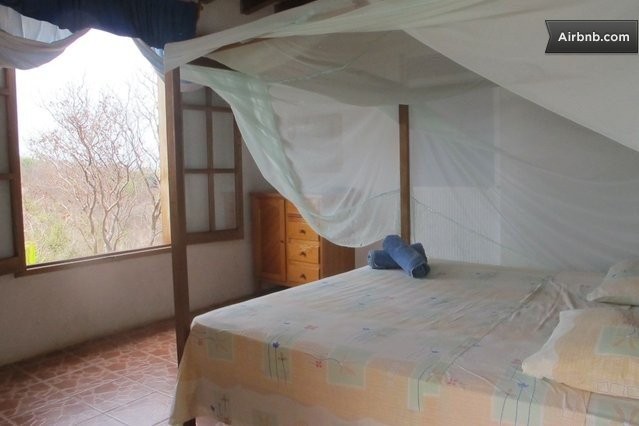
Through the window from our bed we have a great bird-tree. It is tall and has no leaves so I have been able to observe several varieties.   I call these the yellow variety.
I Googled these guys; they are White-throated Magpie Jays.  They do their fly-by just at sunrise and make a raucous noise like really mad chickens.  I love their swooping long tails in flight and their curious top-knot feathers.

Sunday, February 2, 2014

A few days in Paradise

After a chilly two months in Central Mexico we decided to head down to the Oaxaca coast to Mazunte. Here it is; just what we had hoped for, as seen from our lunch table on our arrival.


Our  room for our stay is on the top floor with a hammock on the terrace.  We found Casa Huijazoo on airbnb.com
The sun woke us up the next morning as it rose over the ocean through our, we thought, south facing window. 
It turns out that our views are on an east-west axis off a peninsula.
That means the other ocean view from our window is where the sun sets.
A 10 minute walk took us to Mermejita beach where the sun sets approximately behind where Bryan is standing.  We'll have to test this theory in the next few days.

Wednesday, January 16, 2013

Lunch with Frida


Most market food stalls have pretty boring signs and similar menus.  We stumbled on this eatery deep in the market in Ocotlán de Morelos, about 31 kilometers outside of Oaxaca.


Frida herself brought us a sample plate of 3 moles, a regional specialty, and I chose the dark mole with a hint of chocolate but not the sweetness.  Here it is covering some tasty rolled tacos, paired with a cerveza.

          
And here is Frida, with the eyebrows and the stare, and her admirer.


Monday, January 7, 2013

Christmas Eve in Oaxaca

The Christmas procession around the main square in Oaxaca couldn't have been lovelier. Those are candles lighting the boats. 

Wednesday, January 2, 2013

Radishes, radishes

I've learned a lot about radishes this Christmas in Oaxaca.  For instance, radish carving in Oaxaca began sometime after the the Spanish introduced giant radishes as a crop in the 16th century.  There was already a strong tradition of wood carving so shopkeepers started embellishing their market displays with carved radishes. This developed into the current competion with hefty cash prizes.

For the most part these are not the shiny red radishes we are used to, as seen here in the nearby town of Ocotlán de Morelos.
 They are really big ugly ones, often weighing 5 pounds or more.
Contestants arrive in the Oaxaca town center, the zócalo, the morning of Dec. 23 to create their dioramas.  Some have obviously been preparing all night.
This is a popular tourist attraction so it is best to arrive as close as possible to 11am to avoid the long viewing lines that circle the zócalo well into the night.

The scenes are often religious. This is the lovely la Virgin de Soledád (Oaxaca's patron saint). 


Here is a detail of her sweet face.


And here is a delightful folkloric dancer in traditional dress with a pineapple on her shoulder.


But the truly fun ones are the fanciful and grotesque monsters.


I'll leave you with this one. Words escape me.


Friday, April 13, 2012

Traditional Medicine in San Cristóbal

Traditional medicine is experiencing a resurgence in San Cristóbal. The Museum of Mayan Medicine is dedicated to collecting and recording techniques of indigenous healers in the highlands around the area.  We watched a fascinating video on traditional childbirth as practiced in the region. 
This museum display shows the father's involvement; he supports the mother while the midwife guides the delivery from behind.

The museum highlighted a campaign to discourage the drinking of Coca Cola but it is an uphill battle considering how intertwined it is in local culture.

The most interesting part for me was the small building behind the museum where medicines are concocted and people can meet with a curer and buy those medicines.  They have an international  volunteer program if you are interested.

We also visited the office and home of Dr. Sergio Castro, an incredible humanitarian who was trained as a veterinarian and sent from his home in northern Mexico to complete volunteer work in Chiapas 45 years ago.  He has since dedicated his life to helping the indigenous populations of Chiapas.  Such a beautiful man.
In gratitude, and in lieu of money, many patients have given him their exquisite traditional dress which he has displayed in his home.  We were fortunate to find him there.
He says that right now their most pressing medical problems are  burn injuries and
foot injuries related to diabetes since they walk so much.

Next: Shopping!


Tuesday, April 10, 2012

Places to eat in San Cristóbal, Chiapas

High on my list of things to do is sitting at one of the many sidewalk restaurants; there are several major walking streets which encourage sidewalk cafes and people watching. This cafe is Argentinian and rather a splurge but later we found they have a small torta (sandwich) shop around the corner. Yum.


Breakfast is a special pleasure for us and Chiapas definitely has tasty coffee; we brought home a kilo of beans. This particular restaurant, Madre Tierra, had the absolute best mandarin orange marmalade anywhere.  I loved the fresh fruit, fresh orange juice, coffee and eggs, but all I really wanted was the marmalade.  There was a small shop attached but they didn't have any jars left. 


A not-to-be missed restaurant in the center of town is TierrAdentro, part of a Zapatista cooperative with craft and souvenir shops, coffee sales and music. The menu, which included carefully prepared Mexican dishes and amazing pizza, was excellent each time we ate there. The restaurant draws plenty of tourists who want to have the Zapatista experience.  The  movement still exists and Zapatistas control many cooperative villages.
This painting in the entrance to TerrAdentro summarizes the melding of the Zapatista way of life with crossed bandaleros and a scarf covering the face of the beatific Guadalupe.

Next: Traditional medicine


Monday, April 2, 2012

San Juan Chamula, Chiapas

First up was a visit to San Juan Chamula. We had visited last year but this time we decided we needed a guide.  We found a knowledgeable, articulate young man from the area who did his best to convey the complex history and customs of the town about 6 miles outside of San Cristóbal.
We learned, for example, that most of the residents of the area are of direct Mayan descent and that there are at least 6 distinct Mayan languages spoken in the area.  The pine boughs and colorful symbols on this cross and the addition of a soda bottle and Christ figure in this cemetery represent the the blend of Catholic and Mayan traditions.
I had never seen a cemetery where there were multiple burials, as shown by the number of crosses within the same plot.  
The church itself incorporates the same symbolism as on the cross above with the colorful flower and butterfly images surrounding the entrance.

 
No photographs are allowed within the church, and in fact you could be arrested if you attempt to take photos of people so best to keep your camera tucked away, except for church and cemetery long-shots.

Inside the church there are no pews or altar and the floors are covered in pine boughs.  Ancient cloth and ribbon draped statues of the saints surround the interior while tiny candles the length of my finger burn in rows on the floor. Clouds of incense billow around bottles of soda (mostly Coca Cola) which is drunk symbolically to exorcise the bad spirits through burping.  At times, chickens are slaughtered, although we didn't see this.  Yes, it is hard to explain because it is so different from anything I have experienced but the overall feeling within the church is spiritual and extremely moving.

The social network of the town is collective. There is no external military presence because Chamula has it's own police force.  While we were there we watched the community arrive at a decision.
The men gathered in and in front of the central gazebo while the women observed from the rear. There were multiple speeches until a man with a CocaCola laden dolly appeared.  Cokes were passed around, people seemed to agree on the decision and they rapidly dispersed to waiting trucks to return to their homes.  Chamula justice in action.

A close look at the 3 women observing the meeting in the left center of the above photo shows that their skirts are actually sheep skins, the traditional skirt of choice.  
This woman in the market in San Cristóbal wears hers belted and wrapped in the traditional style.   Men mostly wear jeans and shirts but for official occasions they may wear long sheepskin vests.

This little girl, from a nearby village, wears a typical hand embroidered blouse of the region.  Girls this young often wear the sheepskin skirts as well.